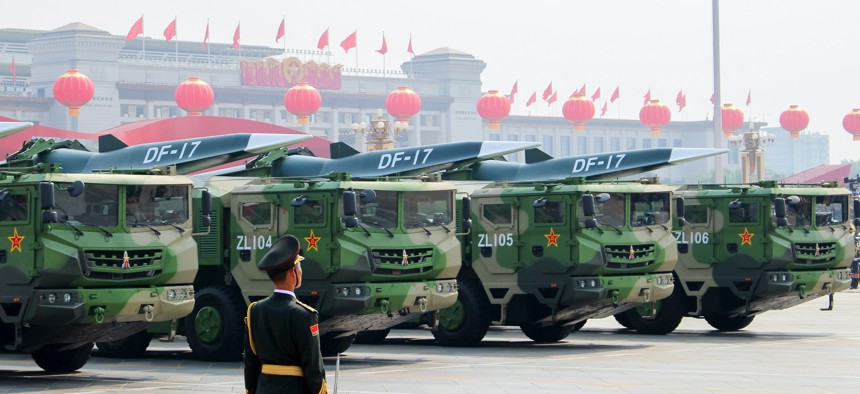
A hypersonic missile that China launched into space this summer “did circle the globe,” a U.S. official confirmed to Defense One, and the Pentagon is still working through the implications of the surprise test.
The July 27 launch, first reported by the Financial Times, took place as top U.S. military leaders were focused on the rapid fall of Afghanistan and then the 17-day sprint to evacuate more than 124,000 people from Hamid Karzai International Airport.
Senior leaders are now focused more directly on the launch and its implications, the U.S. official said.
In an interview with Bloomberg Television on Wednesday, Joint Chiefs Chairman Gen. Mark Milley said of the hypersonic launch, “I don’t know if it’s quite a Sputnik moment, but I think it’s very close to that. It has all of our attention.”
China’s foreign ministry has described the launch as a peaceful test of a space vehicle.
At a Pentagon press briefing Wednesday afternoon, spokesman John Kirby was asked if defense leaders also view the launch as a possible “Sputnik moment.”
“I don’t think it does any good for us to characterize this and put a label on it, this advancement of capabilities,” Kirby said.
The Financial Times, citing multiple unnamed officials, reported that it was a hypersonic missile, capable of carrying a nuclear warhead, that circled the globe and then headed toward its target.
Arizona Democratic Rep. Ruben Gallego said the launch is a wake-up call to re-calibrate U.S. defense priorities.
“I don’t think it’s time for us to panic, but it certainly requires us to refocus,” said Gallego, a Marine Corps and Iraq War veteran who sits on the House Armed Services Committee.
“We’ve been very aware here on the armed services committee that we’ve been behind the eight ball when it comes to investments in hypersonics, hypersonic research,” he said at the Defense One National Security Forum Wednesday. “We are quickly catching up. But it does show other indications of problems, the fact that we didn’t have the intelligence capability to see this coming, the fact that it took awhile for us to confirm this.”
Milley’s acknowledgement of the launch comes as Pentagon leaders argue about whether the U.S. has fallen dangerously behind China in software and artificial intelligence, a concern that prompted last month’s resignation of the Air Force’s chief software officer.

