The U.S. reported more than 35,200 new cases of the coronavirus on Thursday, its highest daily tally since Sep. 5, according to data compiled by Johns Hopkins University. The holiday weekend likely impacted the data over the past few days and is only now beginning to stabilize. The seven-day average of daily new cases has fallen to 35,219, down more than 12% compared with a week ago.
Coronavirus live updates: Israel reportedly heads for second nationwide lockdown; Heathrow reports 81.5% drop in travelers
This is CNBC’s live blog covering all the latest news on the coronavirus outbreak. This blog will be updated throughout the day as the news breaks.

The following data was compiled by Johns Hopkins University:
Global cases: More than 28.2 million
Global deaths: At least 910,100
U.S. cases: More than 6.39 million
U.S. deaths: At least 191,800
CDC report finds dining out has increased Covid-19 risk

Two people with scooters wear masks walk down 46th Street which has been temporarily converted to “Restaurant Row” for outdoor dining during the fourth phase of the coronavirus pandemic reopening in New York, New York.
Roy Rochlin | Getty Images
A new study by the Centers for Disease Control and Prevention found that dining out increases the risk of coronavirus infection more than other social activities, NBC News reports.
The CDC analyzed 314 people who reported Covid-19 symptoms and asked about their activities prior to testing for the virus. The study found that those with positive test results were about twice as likely to have dined at a restaurant than those who tested negative. Infected participants who had no known exposure to the virus also were more likely to have visited a bar or coffee shop in the previous two weeks.
Dr. Todd Rice, a co-author of the report, says the findings make sense because it’s impossible to wear a mask while eating and drinking. Individuals are also often seated in close proximity to one another at a restaurant.
Notably, the study did not identify whether or not participants ate or drank indoors or outdoors. Experts still say outdoor areas are safer than indoor spaces due to increased ventilation. The CDC maintains that drive-thru, delivery, take-out and curbside pick-up dining have the lowest risk for transmission. —Hannah Miao
Towns with college students among hottest outbreaks, report says
Towns with large college student populations represent 19 of the 25 hottest outbreaks in the U.S., according to a USA Today report analyzing data compiled by Johns Hopkins University. The analysis compiled data from counties with at least 50,000, and college towns had to have an enrollment where students were at least 10% of the population.
The worst outbreaks included James Madison University in Harrisonburg, Virginia; Washington State University in Whitman County, Washington; and Central Texas College in Coryell County, Texas, according to the report. Students aren’t attending in-person classes in some of the college towns but are still living in local apartments, the report says. — Noah Higgins-Dunn

national
England and Wales’ contact tracing app to launch on Sept. 24

In this photo illustration the official NHS Covid-19 “Test and Trace” contact tracing app is seen on a screen in London, England.
Leon Neal | Getty Images
England and Wales will launch a much-anticipated coronavirus contact tracing app on Sept. 24, the U.K. government announced.
The rollout was heavily delayed after a U-turn that saw London drop its existing app for one based on privacy-focused technology from Apple and Google. The government had previously opted for a “centralized” approach that processes data centrally rather than on individual smartphones.
Pubs, restaurants and cinemas have been urged by the government to put up QR code posters that let users of the new app check in. This would allow the National Health Service’s so-called Test and Trace team to contact people if a Covid-19 outbreak occurs, according to the Department of Health and Social Care.
Contact tracing apps alert people who come into close proximity with someone who has tested positive for Covid-19, the idea being that the “contacts” of that sufferer would then get tested and self-isolate. They were once viewed as a key part of some countries’ plans to lift lockdown restrictions but their effectiveness has since been called into question. —Ryan Browne
London’s Heathrow Airport reports 81.5% August drop in passenger traffic

Passengers in the arrivals concourse at Heathrow Terminal 4, London, as the Government’s Cobra committee is meeting in Downing Street to discuss the threat to the UK from coronavirus.
Steve Parsons | Getty Images
London’s Heathrow Airport said passenger numbers fell 81.5% in August compared with last year, warning that other international airports are recovering from pandemic lows more quickly with more effective testing.
In a statement, Heathrow noted that North American passenger numbers are down by more than 95% compared with last year, adding that Frankfurt airport in Germany has now overtaken Heathrow, “an early warning that Britain’s economy will fall behind if we don’t protect our global trading network.”
“Heathrow urges the Government to introduce testing as an alternative to 14 day quarantine to protect millions of jobs across the UK and to kickstart the economic recovery,” the airport said in a statement. “A robust testing regime should form part of a suite of measures as no one action in the fight against Covid-19 can be seen as a silver bullet.” —Will Feuer
Israel reportedly heads toward nationwide lockdown again
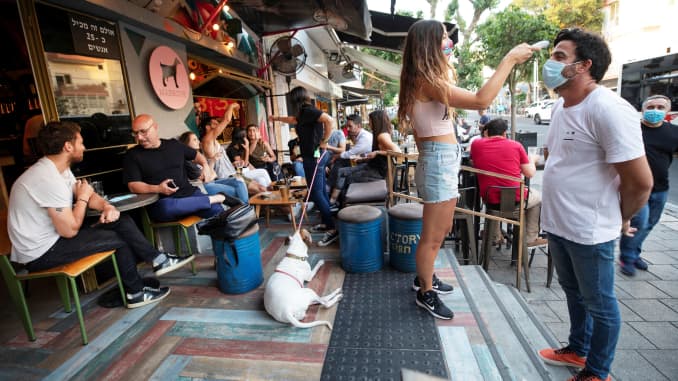
A customer has his temperature taken at the entrance to a Tel Aviv restaurant in early June 2020 after some Israeli businesses reopened following the easing of coronavirus restrictions.
Amir Cohen | Reuters
Israel is preparing to enter a second nationwide lockdown in order to slow the spread of the coronavirus after the country’s effort to reopen society and the economy led to soaring daily infections, according to local media reports.
Israeli ministers voted earlier this week to impose a nationwide lockdown starting sometime next week ahead of the fall holidays observed across the country, The Times of Israel reported. The Times reported that details of the plan are expected to be voted on this weekend, but the lockdown will likely shutter all nonessential businesses and keep people mostly confined to near their homes for at least two weeks.
Early in the outbreak, Israel was hailed for successfully containing the virus, but as the country tried to reopen schools and businesses, the number of daily new cases began to rise in June, according to data compiled by Johns Hopkins University. On Thursday, the country reported over 4,400 new cases, a record number of new cases in a single day, according to data from Hopkins. —Will Feuer
Read CNBC’s previous live coverage here:
0.00%(0)
0.00%(0)
0.00%(0)

