The U.S. reported more than 44,000 new cases of the coronavirus on Thursday, marking an 11% drop in the seven-day average of daily new cases compared with last week. CDC Director Dr. Robert Redfield said Thursday that cases will continue to fall as communities continue to practice public health guidelines to bring the virus under control. Across the country, though, universities and colleges are struggling to keep the coronavirus off campuses and are largely attributing outbreaks to students who aren’t complying with public health requirements.
Coronavirus live updates: Hong Kong plans mass testing; former FDA chief warns of a ‘third act’ of the virus
This is CNBC’s live blog covering all the latest news on the coronavirus outbreak. This blog will be updated throughout the day as the news breaks.
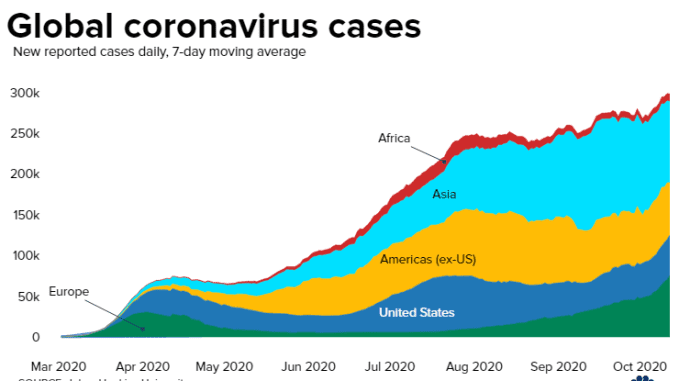
The following data was compiled by Johns Hopkins University:
Global cases: More than 22.7 million
Global deaths: At least 794,100
U.S. cases: More than 5.57 million
U.S. deaths: At least 174,200
Major movie theaters reopen this week: Will audiences show up?
AMC, Regal, Cinemark, Marcus and other major theater chains are reopening their doors after five long months of being shuttered due to the coronavirus outbreak. But even stringent safety protocols and new films may not be enough to lure consumers back to cinemas.
A survey from Morning Consult, a global data intelligence company, suggests that roughly 17% of consumers feel comfortable going back to the movies. That’s down from around 20% of respondents in mid-July.
That said, a poll by Atom Tickets, an online movie ticket seller, found that figure could be closer to 40%, with upwards of 70% ready to go back to theaters within a month. —Sarah Whitten
Stocks open flat as Wall Street tries to end a record week on a high note
U.S. stocks opened flat as concerns over the economy and a new coronavirus stimulus bill dampened market sentiment, reports CNBC’s Fred Imbert.
The Dow Jones Industrial Average traded just 38 points higher, or 0.1%. The S&P 500 hovered around breakeven along with the Nasdaq Composite. —Melodie Warner

national
Former FDA chief warns of ‘third act’ of virus
watch now
The U.S. has not yet had a “true second wave” of the coronavirus and the country could see a resurgence of the virus in the fall and winter, former Food and Drug Administration Commissioner Dr. Scott Gottlieb told CNBC.
“I think most peoples’ perception is we had one epidemic in New York, in the New York region, we came down the epidemic curve, we had another epidemic in the Sun Belt, so that really looks like and feels like a second wave,” Gottlieb said on “Squawk Box.” “I do think that we’re going to have a third act of this virus in the fall and the winter and it’s likely to be more pervasive spread in a broader part of the country.”
He added that the virus is likely to hit rural parts of the country, some of which have been “largely unaffected to date.” Cases are already beginning to build in the West and Midwest, Gottlieb said, adding that “every community is vulnerable.” —Will Feuer
Disclosure: Scott Gottlieb is a CNBC contributor and is a member of the boards of Pfizer, genetic-testing start-up Tempus and biotech company Illumina. He also serves as co-chair of Norwegian Cruise Line Holdings’ and Royal Caribbean’s “Healthy Sail Panel.”
Hong Kong to conduct mass testing
Hong Kong will conduct mass testing for the coronavirus among its residents beginning Sept. 1 as the city grapples with rising cases, Chief Executive Carrie Lam said, according to Reuters.
A 60-person team from China’s mainland will assist Hong Kong officials with the effort, marking the first time Chinese health officials have assisted the special administrative region’s response to the outbreak. The city has now reported more than 4,600 cases of the virus, up from over 1,200 on July 1, according to local authorities.
Some public health specialists in the U.S. have called for a similar ramp-up of mass testing, even if it means relying on less accurate but more accessible surveillance tests instead of the molecular diagnostic tests. However, the Department of Health and Human Services has repeatedly defended the current U.S. testing strategy as adequate. —Will Feuer
Read CNBC’s previous live coverage here:
0.00%(0)
0.00%(0)
0.00%(0)

