关于毛泽东:与一个天主教徒的对话
一篇彻底改变美国同事对毛泽东看法的文章 -----《纪念白求恩》http://bbs.huanqiu.com/lishichafang/thread-256909-1-44.html
作 者:寒梅
换了一个工作团队。跟几个同事“旷日持久”的争论了近两个月, 关于毛泽东。 其中一位天主教同事最“顽固”,. ....渐渐的,他有些怀疑自己一直以来的认为。导致他最后转变的是毛 主席的一篇文章------《纪念白求恩》。把我们几次争论整理了一下, 贴在下面。
同事:毛的共产主义是灾难。共产主义 失败了。没有人再相信它。
我:我不这样认为。
同事:它不能继续了难道这不是最好的证明吗?中国正在经历问题。
我:中国的问题不是共产主义的问 题。
同事:但中国是共产主义国家。
我:我认为我们还不是,我们是共产党执政的国家,他们有共产主义信仰。
同事:这是我 对毛和共产主义不能接受的。
我:不能接受共产党员们有共产主义信 仰?
同事:不能接受他们强迫所有中国人都相信共产主义。
我:我不认为存在强迫。
同事:但毛要建立共产主义国家。
我:这点我不反对。
同事:这就是强迫。他剥夺了上帝赋予人们的权利,选择的权利。
我:这种权利曾经在中国存在过吗?
同事错愕。
我:这才是值得思考的问题,不是吗?上帝赋予人的权利,在中国,对中国人来说,共产党之前也从来没 有拥有过。 用上帝赋予的权力去质疑中国是不公平的。
同事:没有 感受过上帝的慈爱,这是中国人的不幸,我为中国人感到难过。
我: 我只是在说一个事实。大部分中国人不知道上帝。
同事:这不是上帝 的问题。
我:那么是谁的问题?
.
.
.
我:知 道白求恩吗?
同事:不知道。
我:加拿大人。毛写过一篇纪念他的文章,你不妨看看。我会email给你。
第二天一早,同事一到办公室就找到我。
同事:我只想说非常感谢你。
我惊讶:怎么回事?
同事:我昨天晚上看了你传给 我的那篇文章,毛的文章,《纪念白求恩》。 我没有想到,毛会写出这样的文章。
接着同事拿出打印的纸,大声朗读了起来:
“Comrade Bethune's spirit, his utter devotion to others without any thought of self, was shown in his great sense of responsibility in his work and his great warm-heartedness towards all comrades and the people。. Every Communist must learn from him. There are not a few people who are irresponsible in their work, preferring the light and shirking the heavy, passing the burdensome tasks on to others and choosing the easy ones for themselves. At every turn they think of themselves before others. When they make some small contribution, they swell with pride and brag about it for fear that others will not know. They feel no warmth towards comrades and the people but are cold, indifferent and apathetic.” 同事继续:“Now we are all commemorating him, which shows how profoundly his spirit inspires everyone. We must all learn the spirit of absolute selflessness from him. With this spirit everyone can be very useful to the people. A man's ability may be great or small, but if he has this spirit, he is already noble-minded and pure, a man of moral integrity and above vulgar interests, a man who is of value to the people. ”
读完后,同事对我说:“我很震惊。如 果你不告诉我这是毛写的,如果我把里面所有共产主义或意识形态字眼去掉,如果有人在我面前朗读,我会以为我在聆听上帝宣讲。 毛说的这些,和我曾经在教堂听到过的几乎完全一样。”
更多精彩内容,请点击环球网论坛(http://bbs.huanqiu.com)
同 事伸出手来,“我真得非常感谢你。你让我看到了不一样的毛,我想我开始尊敬他了。 我更感谢的是,我突然心变得很开阔了,我觉着整个世界的门在朝我打开,共产主义和毛已经不再是我心里的障碍,我更了解了中国,我非常高兴,我可以拥抱这 些,我想就可以拥抱一切。” 同事笑了,笑得非常灿烂。从我认识他以来,每次总是看到他绅士的、彬彬有礼的微笑,从来没有看到过他笑的这么彻底,像绽裂开的花。
更多精彩内容,请点击环球网论坛(http://bbs.huanqiu.com)
作 者:寒梅
换了一个工作团队。跟几个同事“旷日持久”的争论了近两个月,关于毛泽东。 其中一位天主教同事 最“顽固”, 渐渐的,他有些怀疑自己一直以来的认为。导致他最后转变的是毛 主席的一篇文章------《纪念白求恩》。把我们几次争论整理了一下,贴在下面。
同事:毛的共产主义是灾难。共 产主义失败了。没有人再相信它。
我:我不这样认为。
同事:它不能继续了难道这不是最好的证明吗?中国正在经历问题。
我:中国的问题不是共产主义 的问题。
同事:但中国是共产主义国家。
我:我认为我们还不是,我们是共产党执政的国家,他们有共产主义信仰。
同 事:这是我对毛和共产主义不能接受的。
我:不能接受共产党员们有共产主义信仰?
同事:不能接受他们强迫所有中国人都相信共产主义。
我:我不认为存在强迫。
同 事:但毛要建立共产主义国家。
我:这点我不反对。
同事:这就是强迫。他剥夺了上帝赋予人们的权利,选择的权利。
我:这种权利曾经 在中国存在过吗?
同事错愕。
我:这才是值得思考的问题,不是吗?上帝赋予人的权利,在中国,对中国人来说,共产党之前也从来没有拥有 过。 用上帝赋予的权力去质疑中国是不公平的。
同事:没有感受过上帝的慈爱,这是中国人的不幸,我为中国人感到难过。
我:我只是在说一个 事实。大部分中国人不知道上帝。
同事:这不是上帝的问题。
我:那么是谁的问题?
.
.
.
我: 知道白求恩吗?
同事:不知道。
我:加拿大人。毛写过一篇纪念他的文章,你不妨看看。我会email给你。
第二天 一早,同事一到办公室就找到我。
同事:我只想说非常感谢你。
我惊讶:怎么回事?
同事:我昨天晚上看了你传给我的那篇文章,毛的文 章,《纪念白求恩》。 我没有想到,毛会写出这样的文章。
接着同事拿出打印的纸,大声朗读了起来:
“Comrade Bethune's spirit, his utter devotion to others without any thought of self, was shown in his great sense of responsibility in his work and his great warm-heartedness towards all comrades and the people。. Every Communist must learn from him. There are not a few people who are irresponsible in their work, preferring the light and shirking the heavy, passing the burdensome tasks on to others and choosing the easy ones for themselves. At every turn they think of themselves before others. When they make some small contribution, they swell with pride and brag about it for fear that others will not know. They feel no warmth towards comrades and the people but are cold, indifferent and apathetic.”
同事继续:“Now we are all commemorating him, which shows how profoundly his spirit inspires everyone. We must all learn the spirit of absolute selflessness from him. With this spirit everyone can be very useful to the people. A man's ability may be great or small, but if he has this spirit, he is already noble-minded and pure, a man of moral integrity and above vulgar interests, a man who is of value to the people. ”
读完后,同事对我说:“我很震 惊。如果你不告诉我这是毛写的,如果我把里面所有共产主义或意识形态字眼去掉,如果有人在我面前朗读,我会以为我在聆听上帝宣讲。 毛说的这些,和我曾经在教堂听到过的几乎完全一样。”
更多精彩内容,请点击环球网论坛(http://bbs.huanqiu.com)
同事伸出手来,“我真得非常感 谢你。你让我看到了不一样的毛,我想我开始尊敬他了。 我更感谢的是,我突然心变得很开阔了,我觉着整个世界的门在朝我打开,共产主义和毛已经不再是我心里的障碍,我更了解了中国,我非常高兴,我可以拥抱这 些,我想就可以拥抱一切。” 同事笑了,笑得非常灿烂。从我认识他以来,每次总是看到他绅士的、彬彬有礼的微笑,从来没有看到过他笑的这么彻底,像绽裂开的花。
IN MEMORY OF NORMAN BETHUNE

December 21, 1939
纪念白求恩
毛主席
( 一九三九年十二月二十一日 )
白求恩同志是加拿大共产党员,五十多岁了,为了帮助中国的抗日战争,
受加拿大共产党和美国共产党的派遣,不远万里,来到中国,去年春上到延安,后来到五台山工作,不幸以身殉职,一个外国人,毫无利己的动机,把中国人民的解放事业当作他自己的事业,这是 什么精神?这是国际主义的精神,这是共产主义的精神,每一个中国共产党员 都要学习这种精神。列宁主义认为:资本主义国家的无产阶级要拥护殖民地半殖民地人民的解放斗争,殖民地半殖民地的无产阶级要拥护资本主义国家的无产阶级的解放斗争,世界革命才能胜利。白求恩同志是实践了这一条列宁主义路线的。我们中国 共产党员也要实践这一条路线。我们要和一切资本主义国家的无产阶级联合起 来,要和日本的、英国的、美国的、德国的、意大利的以及一切资本主义国家的无产阶级联合起来,才能打倒帝国主义,解放我们的民族和人民,解放世界的民族和 人民。这就是我们的国际主义,这就是我们用以反对狭隘民族主义和狭隘爱国主义的国际主义。
Comrade Norman Bethune,a member of the Communist Party of Canada, was
around fifty when he was sent by the Communist Parties of Canada and the
United States to China; he made light of travelling thousands of miles
to help us in our War of Resistance Against Japan. He arrived in Yenan
in the spring of last year, went to work in the Wutai Mountains, and to
our great sorrow died a martyr at his post. What kind of spirit is this
that makes a foreigner selflessly adopt the cause of the Chinese
people's liberation as his own? It is the spirit of internationalism,
the spirit of communism, from which every Chinese Communist must learn.
Leninism teaches that the world revolution can only succeed if the
proletariat of the capitalist countries supports the struggle for
liberation of the colonial and semi-colonial peoples and if the
proletariat of the colonies and semi-colonies supports that of the
proletariat of the capitalist countries.Comrade Bethune put this
Leninist line into practice. We Chinese Communists must also follow this
line in our practice. We must unite with the proletariat of all the
capitalist countries, with the proletariat of Japan, Britain, the United
States, Germany, Italy and all other capitalist countries, for this is
the only way to overthrow imperialism, to liberate our nation and people
and to liberate the other nations and peoples of the world. This is our
internationalism, the internationalism with which we oppose both narrow
nationalism and narrow patriotism.
白求恩同志毫不利己专门利人的精神,表现在他对工作的极端的负责任,对同志对人民的极端的热忱。每 个共产党员都要学习他。不少的人对工作不负责任,拈轻怕重 ,把重担于推给人家,自己挑轻的。-事当前,先替自己打算,然后再替别人打算。出了点力就觉得了不 起,喜欢自吹,生怕人家不知道。对同志对人民不是满腔热忱,而是冷冷清 清,漠不关心,麻木不仁。这种人其实不是共产党员,至少不能算一个纯粹的共产党员。从前线回来的人说到白求恩,没有一个不佩服,没有一个不为他的精神所感动。晋察冀边区的军民,凡亲身受过白求恩医生的治疗和亲眼看过白求恩医生的工作的, 无不为之感动。每一个共产党员,一定要学习白求恩同志的这种真正共产主义 者的精神。
Comrade Bethune's spirit, his utter devotion to others without any
thought of self, was shown in his great sense of responsibility in his
work and his great warm-heartedness towards all comrades and the people.
Every Communist must learn from him. There are not a few people who are
irresponsible in their work, preferring the light and shirking the
heavy, passing the burdensome tasks on to others and choosing the easy
ones for themselves. At every turn they think of themselves before
others. When they make some small contribution, they swell with pride
and brag about it for fear that others will not know. They feel no
warmth towards comrades and the people but are cold, indifferent and
apathetic. In truth such people are not Communists, or at least cannot
be counted as devoted Communists. No one who returned from the front
failed to express admiration for Bethune whenever his name was
mentioned, and none remained unmoved by his spirit. In the
Shansi-Chahar-Hopei border area, no soldier or civilian was unmoved who
had been treated by Dr. Bethune or had seen how he worked. Every
Communist must learn this true communist spirit from Comrade Bethune.
白求恩同志是个医生,他以医疗为职业,对技术精益求精;
整个八路军医务系统中,他的医术是很高明的。这对于一班见异思迁的人,对于一班鄙薄技术工作以为不足道、以为无出路的人,也是一个极好的教训。
Comrade Bethune was a doctor, the art of healing was his profession and
he was constantly perfecting his skill, which stood very high in the
Eighth Route Army's medical service. His example is an excellent lesson
for those people who wish to change their work the moment they see
something different and for those who despise technical work as of no
consequence or no promising future.
我和白求恩同志只见过一面。后来他给我来过许多信。可是因为忙,仅回过他一封信,还不知他收到没 有。对于他的死,我是很悲痛的。现在大家纪念他,可见他的精神感人之深。 我们大家要学习他毫无自私自利之心的精神。从这点出发,就可以变为大有利于人民的人。一个人能力有大小,但只要有这点精神,就是一个高尚的人,一个纯粹的人,一个有道德的人,一个脱离了低级趣味的人,一个有益于人民的人。
Comrade Bethune and I met only once. Afterwards he wrote me many
letters. But I was busy, and I wrote him only one letter and do not even
know if he ever received it. I am deeply grieved over his death. Now we
are all commemorating him, which shows how profoundly his spirit
inspires everyone. We must all learn the spirit of absolute selflessness
from him. With this spirit everyone can be very useful to the people. A
man's ability may be great or small, but if he has this spirit, he is
already noble-minded and pure, a man of moral integrity and above vulgar
interests, a man who is of value to the people.

_____________
白求恩也有人的七情六欲,也年轻疯狂过,可是他有两点非常优秀: 优秀的医学学业和伟大优秀的胸怀和思想。所以,他能够抛弃疯狂跟享受,一投入中国的解放事业就无私快乐地奉献起来,直到牺牲。
In the fall of 1936, Bethune (1890-1939) was invited to head a Canadian medical team in Spain and in 6 months or so developed what was, for its time, a highly sophisticated blood transfusion service. Restless as ever, in the fall of 1937, he volunteered for a medical mission to China, with the "leftist" forces under Mao, where he worked tirelessly till his death in November 1939 from septicemia contracted during a surgical operation. 

" 他是一个少有的人,共产党员就应该像白求恩这样。"
-----------斯图尔特
斯图尔特1934年生于加 拿大,30岁时才真正认识到白求恩的价值。他在1973年接受CBC采访内容,侧面反映了加拿大人对白求恩认识的转变过程。“1964年,加拿大国家电影 局拍摄了电影《白求恩》。我当时是一所中学的历史老师,学校里两个班级学生还有一些医生看完这部电影后非常感动,在我办公室畅谈良久。有个学生告诉我,他 从未想过献身医务界,因为他的父亲就是个医生,买了3个车库,这就是一名医护工作者的成就吗?是《白求恩》这部电影也震撼了我! 学生的话更让我觉得应该做些什么,于是开始写有关白求恩的书。”


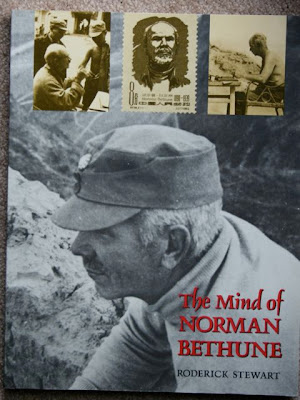
Norman Bethune
The Mind of Norman Bethune
by Roderick Stewart, 230 pp, with illus, paper, $16.95, ISBN 1-55041-601-4, Markham, Ontario, Fitzhenry & Whiteside, http://www.fitzhenry.ca, 1977, revised 2002.
This is an unusual biography of an unusual and enigmatic physician, drawn mainly from his letters, speeches, radio broadcasts, medical and political articles, poetry, drawings, paintings, and photographs. The extracts from Bethune's own materials are linked by concise but informative biographical notes by the author. Both write in a fluent readable style.
Norman Bethune's family background is one of many and varied interests, activities, and achievements. His father was an "adventurer," converted to an acerbic Presbyterianism by his evangelical wife, and an outspoken man of high principle. Bethune's paternal grandfather was a mid-Victorian academic surgeon, practicing in Toronto, Ontario, and Edinburgh, Scotland, and also an accomplished amateur artist and poet. Earlier ancestors included a fur trader and partner in the Hudson Bay Company, and a minister of religion who moved to Canada after being a prisoner-of-war in the war of American independence. Other relatives occupied major academic and religious positions.
Bethune (1890-1939) evolved from this background with talents and character traits in medicine, arts, writing, social conscience, and politics, which are reflected in both the variety of his activities and the major aspects of his career for which he is best known: he initiated a mobile blood transfusion service in support of the Republican forces and International Brigade in the Spanish Civil War and was a physician-surgeon in the Chinese Communist forces under Mao Zedong.
Bethune interrupted his medical studies at the University of Toronto to serve as a stretcher bearer in Flanders, Belgium, until wounded in 1915, when he returned to complete his medical studies. He subsequently served in the Royal Navy and the Royal Canadian Air Force. Trained as a surgeon in London, England (financed by trading in objets d'art), he returned to North America with his Edinburgh-born wife, setting up practice in Detroit, Mich. The marriage was a stormy one characterized by incompatibility combined with mutual fascination; they married and divorced twice. In 1927, in Detroit, he fell ill with pulmonary tuberculosis and also underwent the first divorce. This led to a period of introspection and artistic and poetic output, which is revealing of his nature.
Following this experience, he trained and later practiced as a thoracic surgeon in Montreal, Quebec, where he came to prominence in the wider academic surgical community. His imaginative mind led to development of numerous devices to improve surgical practice. During his time in Montreal, his exposure to poverty and disease drove him more and more to socialistic and, later, communistic philosophies. Outspoken as always, he tended to offend the "establishment." A 1936 Memphis, Tenn, newspaper headline, reporting on his proposals for "socialized medicine," reads "Surgeon Startles Medical Assembly"!
In the fall of 1936, Bethune was invited to head a Canadian medical team in Spain and in 6 months or so developed what was, for its time, a highly sophisticated blood transfusion service. His extravagant personality and clashes with authority led to his return to Canada in May 1937. Restless as ever, in the fall of 1937, he volunteered for a medical mission to China, with the "leftist" forces under Mao, where he worked tirelessly till his death in November 1939 from septicemia contracted during a surgical operation.
The first third of the book documents in Bethune's own eloquent way the evolution of his views of life. The last two thirds describe in stark detail the horrors and miseries of the wars in Spain and China and the enormous difficulties of medical practice in late 1930s China. There are also clear descriptions of contemporary life in northern China. The whole book is comprehensively illustrated with photographs of all aspects of Bethune's life and career and quotes extensively from his often evocative poetry.
The Mind of Norman Bethune should be of interest to anyone who is intrigued by unique and fascinating characters. It should be of particular interest to those studying the social history of medical practice in the first half of the 20th century, the medical history of the Spanish Civil War, and the history of blood transfusion. The accounts of conditions in the wars in northern China should be of value in understanding facets of the evolution of communism in China. It is a little chastening that Bethune is less recognized here, despite his many achievements, than in China, where his name is revered and deeply respected to this day.
P. H. Pinkerton, MD, FRCP, Reviewer
University of Toronto
Ontario, Canada
1938年初,加拿大著名的胸外科专家白求恩大夫到中国来了。他不仅带来了大批药品、显微镜、X光镜和一套手术器械,最可宝贵 的是,他带来了高超的医疗技术,惊人的组织能力和对中国革命战争事业的无限的热忱。 他到达晋察冀边区后方医院后,第一周内就检查了520个伤病员。第二周白求恩大夫就开始施行手术。四个星期的连续工作,使147个伤病员很快又带着健康的 身体回到前线。 从此,哪里有伤员,白求恩大夫就出现在哪里。在晋察冀的一次战斗中,他曾经连续69个小时为115名伤员动了手术。他的手术台,曾经安在离前线五里地的村 中小庙里, 大炮和机关枪在平原上 咆哮着,敌人的炮弹落在手术室后面,爆炸开来,震得小庙上的瓦片格格地响。白求恩大夫却在小庙里紧张地动着手术。他不肯转移,他说:“离火线远了,伤员到 达的时间会延长,死亡率就会增高。战士在火线上都不怕危险,我们怕什么危险?”两天两夜,他一直在手术台上工作着,直到战斗结束。 为了保住伤员的性命,白求恩大夫把自己的鲜血输给了中国战士。
他愉快地称自己是万能输血者,因为他是O型血。他还拿出自己带来的荷兰纯牛乳,亲自到厨房煮牛奶,烤 馒头片,端到重伤员面前。看着他们吃下去,微笑浮在白求恩的脸上。 一次,给一个头部中弹后引起感染的伤员做手术,匆忙之中,他竟忘记戴橡皮手套。切开头颅后,白求恩大夫赤手伸进去,用原已发炎的左手指去摸碎骨,摸到一 片,像是考古 学家突然在什么地方发现了甲骨文似的喜 悦,他立即取出放在盘里,随即又用手指伸进去摸。白求恩大夫的心只注意着伤员,为摸出的一片片碎骨的喜悦情绪占有了。他总是得意地说:“又是一片!要是戴 手套就摸不到了。碎骨铁片取不出来,伤员是很难好的啊!”但是却不知,病员伤口里的细菌,也从白求恩大夫发炎手指的伤口处溜了进去,种下了导致他生命垂危 的毒种。
 |
| 诺尔曼·白求恩 |
最后遗言
 在白求恩病重之时,他给聂荣臻司令员写 了一封信,这是他最后的话。信是这样写的:亲爱的聂司令员:今天我感觉非常不好——也许我会和你永别了!请你给布克写一封信——地址是加拿大托拉托城威灵 顿街第十号门牌。用同样的内容写给国际援华委员会和加拿大民主和平联盟会。告诉他们我在这里十分快乐,我惟一的希望就是能多有贡献。也写信给美国共产党总 书记,并寄上一把日本指挥刀和一把中国大砍刀,报告他我在这边工作的情形。把我所有的相片……日记……文件和军区故事等,一概寄回那边去,由布克负责分 散。并告诉他有一个电影片子将要完成。……将我永不变更的友爱送给布克以及所有我的加拿大和美国的同志们!两个行军床,你和聂夫人留下吧,两双英国皮鞋也 给你穿。骑马的马靴和马裤给冀中区的吕司令员。贺师长也要给一些纪念品……给军区卫生部长两个箱子,尤副部长八种手术器械,凌医生可以拿十五种,卫生学校 的江校长让他任意挑选两种物品做纪念吧。……给我的勤务员邵一平和炊事员老张每人一床毯子,并送给邵一平一双日本皮鞋……每年要买250磅奎宁和300磅 的铁剂,专为疟疾病患者和极大数目的贫血病患者。 千万不要再往保定平津一带去购买药品,因为那边的价钱比沪港贵两倍。 …… 告诉加拿大和美国,我惟一的希望,是能够多有贡献。 ……
 在白求恩的病情已十分危险的时刻,大家很着急,白求恩却平静地说:“我得了脓败血症, 没有办法了……请转告毛主席,我相信中国人民一定会获得解放,遗憾的是我不能亲眼看到新中国诞生了……”


